

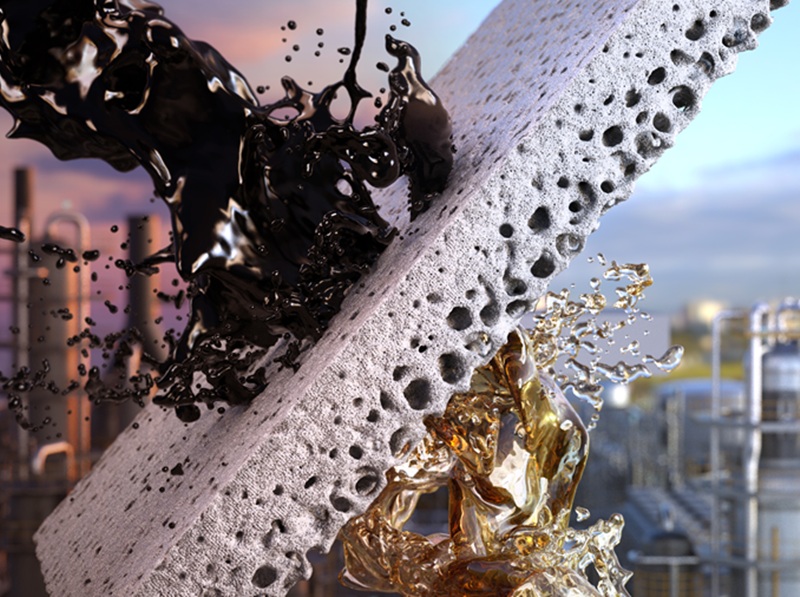
국내 연구진이 원유를 고온으로 끓이지 않고 상온에서 분리할 수 있는 고분자 분리막 기술을 개발했다. A research team at the country’s top science and technology university has developed a polymer membrane technology that separates crude oil at room temperature without heating it to higher temperatures.
과학기술정보통신부가 이 같은 카이스트(KAIST) 고동연 교수 연구진의 연구 결과가 국제학술지 네이처(Nature)에 24일(현지 시간) 게재됐다고 25일 밝혔다.
The Ministry of Science and ICT on June 25 said the findings of the team led by Koh Dong-Yeun, a professor at the School of Chemical and Biomolecular Engineering of the Korea Advanced Institute of Science and Technology (KAIST), were published the day before in the international journal *Nature*.
현재 정유 공정은 원유를 350도 이상으로 가열한 뒤, 끓는점 차이를 이용해 휘발유·등유·경유 등으로 나누는 증류 방식에 의존한다.
Oil refining processes have traditionally relied on distillation, in which crude oil is heated to 350 degrees Celsius or higher and then separated into products such as gasoline, kerosene and diesel based on varying boiling points.
이번 연구에서 연구진은 다공성 고분자 분리막을 이용해 원유 성분을 분리하는 기술을 개발했다.
The KAIST study devised a technology using a porous polymer membrane to separate crude oil components.
실험 결과 새 분리막은 기존 기술보다 분리 속도가 23배 이상 빨랐고, 28일 동안 안정적인 성능을 유지했다.
Experiments found that the new separation membrane was over 23 times faster than conventional technologies while maintaining stable performance for 28 days.
연구진은 이 기술을 활용하면 에너지 사용량은 31.6%, 이산화탄소 배출량은 37.6%, 운영비는 36% 줄일 수 있을 것으로 분석했다.
The team said use of this technology could reduce energy consumption 31.6%, carbon dioxide emissions 37.6% and operating costs 36%.
고 교수는 “이번 연구는 원유가 분리막을 통과하면서 스스로 최적의 분리 통로를 만든다는 새로운 원리를 규명한 성과”라고 설명했다.
Koh said, “This study has identified a new principle in which crude oil creates its own optimal separation pathway while passing through a separation membrane.”
고현정 기자, hjkoh@korea.kr
By Koh Hyunjeong, hjkoh@korea.kr

